For photographers interested in moving beyond 35mm, the used-camera market offers a wide variety of medium-format cameras at different price points. Twin-lens reflex and single-lens reflex systems each provide a different approach to working with 120 film. Common negative sizes include 6×4.5, 6×6, and 6×7 cm, all substantially larger than a 35mm frame. Many older cameras are fully mechanical and can be operated without batteries, making them attractive to photographers who appreciate simplicity and direct control. When choosing a used medium-format camera, mechanical condition, shutter operation, lens quality, and film transport deserve careful attention.
The larger negatives produced by medium-format cameras offer greater potential for fine detail, smoother tonal gradation, and larger enlargements than 35mm film. However, photography students, particularly those studying fine art, may also enjoy experimenting with inexpensive plastic cameras such as the Holga and Diana. Although many of these cameras use 120 film, their simple lenses produce soft images, vignetting, and other optical imperfections that some photographers deliberately seek for artistic effect. They offer an affordable introduction to the format, but are not the best choice for those seeking the sharpness and image quality normally associated with medium-format photography.
Twin-Lens Reflex Cameras: A Traditional Approach to Medium Format
Yashica Mat-124
The Yashica Mat-124 was a popular Japanese twin-lens reflex camera, producing twelve 6×6 cm negatives on 120 film. Equipped with an 80mm Yashinon taking lens, a built-in exposure meter, and crank-operated film advance, it offered many of the conveniences found in more expensive medium-format cameras. An adjustable film pressure plate allowed the camera to accommodate both 120 and 220 roll film, with the latter providing up to 24 exposures per roll.
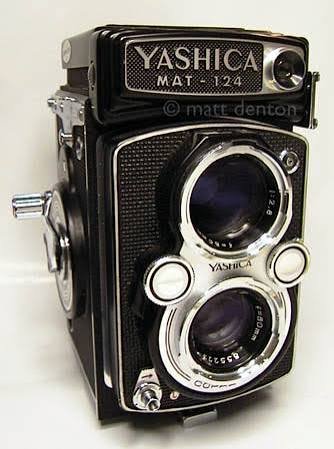
My first twin-lens reflex was a Yashica Mat-124, acquired in the early 1990s. Although it was probably already twenty years old, it generally performed well and introduced me to the pleasures of medium-format photography. However, I experienced recurring film-advance problems, including irregular frame spacing and partially exposed frames, which required repairs on several occasions.
Yashica Mat- 124 G
Despite these difficulties, the Yashica Mat-124 was a capable camera that produced excellent photographs when functioning properly. Yashica subsequently introduced the Mat-124G, an updated version featuring gold-plated electrical contacts in its exposure-meter circuitry, revised internal components, and distinctive black trim. Although the improvements were relatively modest, the 124G became one of Yashica’s best-known twin-lens reflex cameras and remains popular among medium-format enthusiasts. Both models are worth considering, but prospective buyers should carefully examine the film-advance mechanism, shutter operation, exposure meter, and lens condition before purchasing.
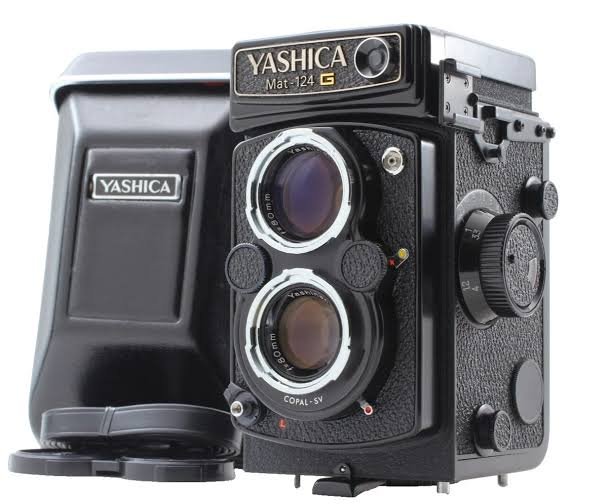
Produced from 1970 to 1986, the Yashica Mat-124G was among the last traditional twin-lens reflex cameras. Its waist-level viewfinder and classic handling remain appealing to medium-format enthusiasts.
Where to buy: Browse Yashica Mat 124 cameras at KEH and Adorama
Rolleicord
Rolleicord cameras, manufactured by Franke & Heidecke in Germany, offered a more affordable alternative to the company’s professional Rolleiflex models. Although generally simpler in design and operation, many Rolleicords were equipped with excellent lenses capable of producing remarkably sharp photographs.
After owning my Yashica Mat-124, I acquired a Rolleicord manufactured in 1952, fitted with a Schneider-Kreuznach Xenar 75mm lens. I was able to confirm its year of manufacture by contacting the company in Germany and providing the camera’s serial number. Despite its age and relatively simple design, the camera produced beautifully sharp, clear negatives and proved a pleasure to use.
Over time, I also managed to obtain several accessories, including lens filters, which were becoming increasingly difficult to find. The camera remains in my collection today and is one of my most cherished pieces of photographic equipment.
For photographers considering a used Rolleicord, careful attention should be given to shutter operation, lens condition, focusing accuracy, and the availability of accessories. A well-maintained example can still deliver outstanding photographic results without the expense of a comparable Rolleiflex.
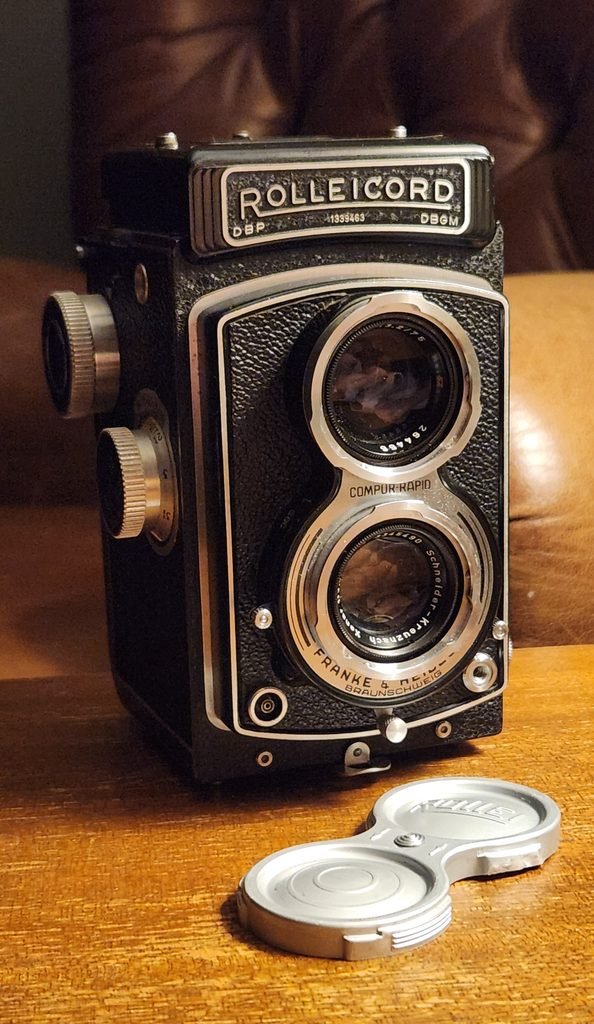
My 1952 Rolleicord
Fitted with a Schneider-Kreuznach Xenar 75mm lens, this near mint condition Rolleicord remains a treasured part of my collection. More than seven decades later, it stands as a testament to the precision craftsmanship and enduring quality of German camera manufacturing.
Other Twin-Lens Reflex Cameras Worth Considering
Beyond Yashica and Rolleicord, several manufacturers produced excellent twin-lens reflex cameras. The Minolta Autocord and Ricoh Diacord remain respected examples, although finding well-maintained cameras for sale can require patience. Rolleiflex cameras, manufactured by Franke & Heidecke in Germany, established an exceptional reputation among professional photographers for their precision engineering, superb optics, and outstanding build quality. Although generally more expensive than their Rolleicord counterparts, well-maintained examples remain highly desirable.
Rolleiflex
Rolleiflex twin-lens reflex cameras were offered with several lens options, including models fitted with 75mm f/3.5 optics. Among the most prestigious were the 2.8 versions, equipped with fast 80mm f/2.8 Carl Zeiss Planar or Schneider Xenotar lenses. Decades of refinement culminated in the Rolleiflex 2.8 GX, introduced in 1987, which combined the classic twin-lens reflex design with modern through-the-lens exposure metering.
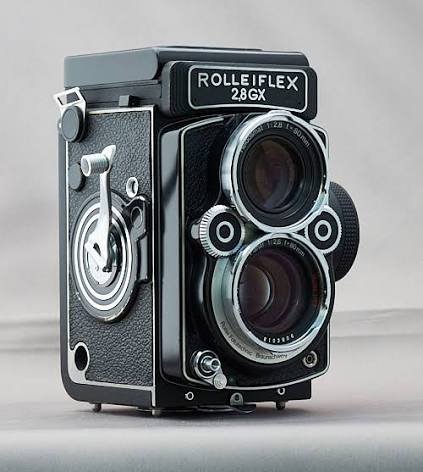
The Rolleiflex became a favorite among professional portrait, fashion, and documentary photographers. Its exceptional build quality, precise controls, and beautifully engineered mechanics helped establish its reputation as one of the finest twin-lens reflex cameras ever made.
Where to buy: Browse Rolleiflex cameras at KEH and Adorama
Mamiya
Of particular interest are Mamiya’s C-series cameras, including the C220 and C330. Unlike most traditional twin-lens reflex designs, these cameras feature interchangeable lens pairs, allowing photographers to select different focal lengths for portraits, landscapes, and other subjects. Both produce 6×6 cm negatives on 120 film and are capable of outstanding photographic results. Their principal disadvantages are their substantial size and weight, along with the additional expense of purchasing interchangeable lenses.
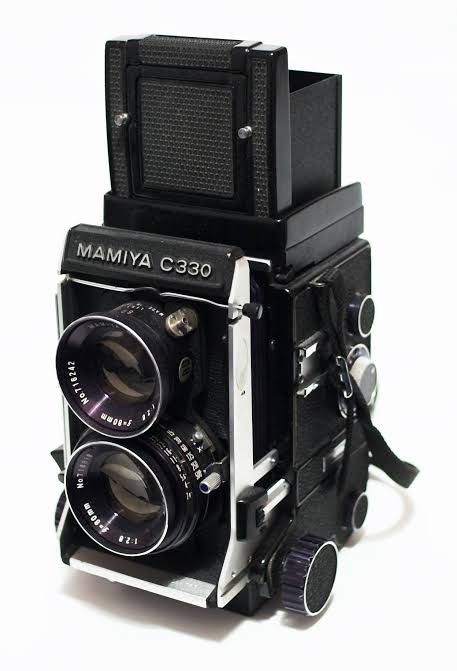
The Mamiya C330 features interchangeable lens pairs, bellows focusing, and automatic shutter cocking during film advance. Its versatility made it particularly popular among professional portrait and studio photographers.
As with any older TLR, buyers should carefully examine shutter operation, lens condition, focusing mechanisms, and film advance before purchasing. A properly functioning, less expensive camera can be a much better investment than a prestigious model requiring extensive repairs.
Where to buy: Browse Mamiya TLRs at KEH and Adorama
Medium-Format Single-Lens Reflex Cameras
Mamiya RB67 Professional Series
The Mamiya RB67 Professional series was widely used by professional portrait, fashion, and studio photographers. Its large 6×7 cm negatives offered excellent detail, while its revolving film back, from which the designation “RB” is derived, allowed photographers to switch between horizontal and vertical compositions without rotating the camera.
I invested considerably in building my own RB67 Pro-S system and appreciated its versatility. The large negatives allowed generous cropping, including square 6×6 compositions, while interchangeable backs offered other formats, including 6×4.5. The original RB67 Professional was introduced in 1970, followed by the improved Pro-S in 1974 and the Pro-SD in 1990. Mamiya also introduced the RZ67 in 1982, a separate, electronically controlled system that continued alongside the mechanical RB67 cameras.
Polaroid backs were also available for instant proofs of exposure, lighting, and composition. Fujifilm offered compatible peel-apart films, including FP-100C and FP-3000B. Unfortunately, both manufacturers discontinued these traditional materials, and today’s Polaroid and Instax films are incompatible with the original backs.
The RB67 delivered outstanding results at a considerably lower cost than the Hasselblad system I had always admired. Like the Hasselblad 500 series, it featured mechanical leaf shutters built into its lenses, allowing flash synchronization at all available shutter speeds. Although exceptionally versatile, its considerable weight and bulk made it better suited to studio photography.
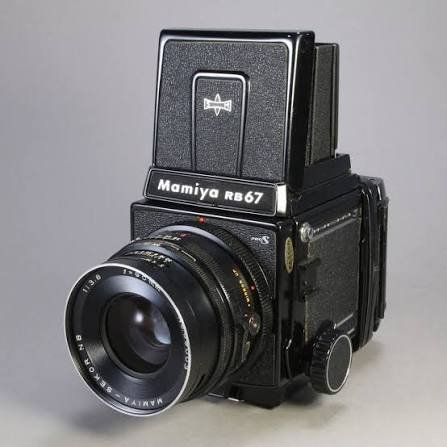
Mamiya RB67 Pro-S
Featured improved safety interlocks to help prevent accidental exposures and film-handling errors. Its rugged, fully mechanical construction and extensive selection of interchangeable lenses and accessories made it a favorite among professional studio photographers.
Hasselblad Medium-Format Cameras
Hasselblad established an exceptional reputation among professional photographers for its precision engineering, modular construction, and outstanding Carl Zeiss lenses. Classic models such as the 500C, 500C/M, and 501CM produced 6×6 cm negatives and offered interchangeable lenses, viewfinders, focusing screens, and film backs.
The traditional 500-series cameras use mechanical leaf shutters built into their lenses, allowing flash synchronization at all shutter speeds without requiring batteries. Hasselblad also produced electrically driven models, including the 500EL/M and 553ELX, as well as advanced 200-series cameras with electronically controlled focal-plane shutters.
Renowned photographers who used Hasselblad equipment include Michael Kenna, celebrated for his atmospheric black-and-white landscapes, and Robert Mapplethorpe, known for his portraits and still-life photographs.
Although generally more expensive than comparable Mamiya and Bronica equipment, a well-maintained Hasselblad remains an attractive choice for photographers seeking a professional medium-format system. Buyers should carefully examine the condition of the lenses, shutters, film backs, and any electronic components.
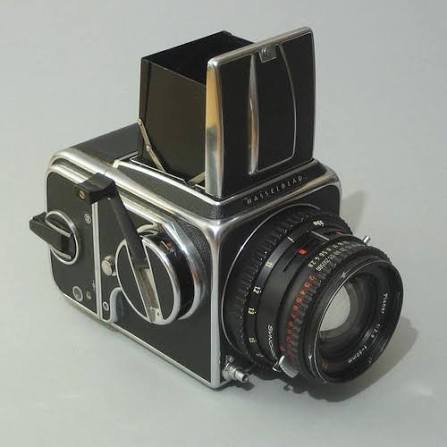
The Hasselblad 500 series offers exceptional image quality, precise manual controls, and remarkable versatility. Its interchangeable components allow photographers to configure the camera for a wide range of photographic applications.
Where to buy: KEH
Other Medium-Format SLR Systems Worth Considering
For photographers seeking alternatives to Hasselblad and the Mamiya RB67, several excellent medium-format SLR systems deserve consideration. The Mamiya 645 and Bronica ETR series produce 6×4.5 cm negatives, while Bronica’s SQ series offers the traditional 6×6 square format. Pentax also produced highly regarded 645 and 6×7 systems, combining excellent optics with handling characteristics familiar to photographers accustomed to 35mm SLRs.
These cameras offer interchangeable lenses and considerable versatility, often at more approachable prices than comparable Hasselblad equipment. Their condition, availability of accessories, and electronic requirements should be carefully considered when purchasing used examples.
Where to buy: Browse medium-format at KEH and Adorama
Mamiya 6 and 7 Rangefinder Cameras
Mamiya also produced two exceptional medium-format rangefinder systems: the Mamiya 6, producing 6×6 cm negatives, and the Mamiya 7, producing 6×7 cm negatives. Both feature interchangeable lenses and relatively compact designs, making them particularly attractive to landscape, travel, and documentary photographers.
Unlike traditional SLRs, these cameras use rangefinder focusing rather than viewing directly through the taking lens. Their outstanding lenses, quiet operation, and portability earned them considerable reputations for image quality. Although generally expensive on the used market, both remain highly desirable alternatives to bulkier medium-format systems.
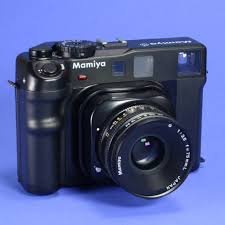
Introduced in 1989, the modern Mamiya 6 is a compact 6×6 rangefinder featuring interchangeable lenses, a retractable lens mount, and exceptional optical performance.
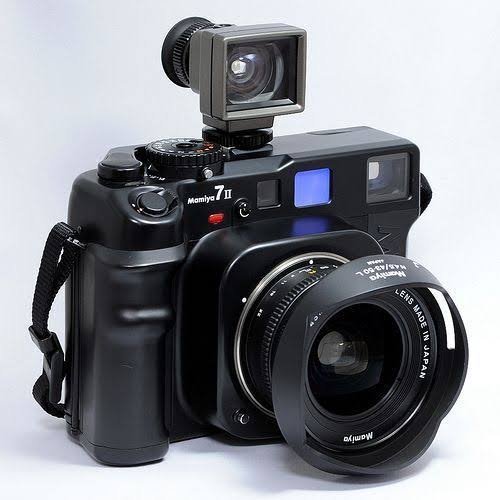
Introduced in 1999, the Mamiya 7II is a refined 6×7 medium-format rangefinder featuring interchangeable lenses, exceptionally sharp optics, and a lightweight, portable design.
Where to buy: KEH
Final Thoughts
Choosing a medium-format film camera involves balancing image quality, versatility, portability, and cost. From traditional twin-lens reflex cameras to sophisticated professional systems, each offers a distinctive photographic experience. Although some of these cameras require a considerable investment, many remain capable of producing extraordinary photographs decades after their manufacture.
For those willing to embrace the deliberate pace of medium-format photography, the rewards can be substantial. Working with larger negatives encourages careful composition, thoughtful exposure, and a greater appreciation of the photographic process. Ultimately, the best camera is not necessarily the most expensive or prestigious, but the one that inspires you to explore your creativity and make photographs that matter.