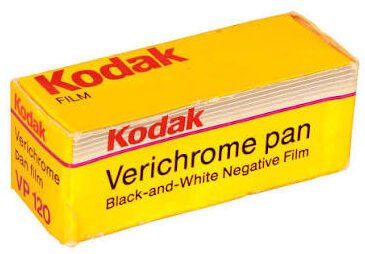
Kodak Verichrome Pan holds a special place in my memories of traditional black-and-white photography. Although manufactured in several formats, including 120, 620, and sheet film, it was never offered in 35mm. I particularly enjoyed using Verichrome Pan in 120 roll-film format, where its smooth tonal transitions, pleasing greyscale, and generous exposure latitude made it one of my favourite films for portraiture and landscape photography.
When enlarged to 8×10 or 11×14 inches, Verichrome Pan produced prints with a tonal richness I particularly appreciated. Even larger enlargements were possible, especially when using my Mamiya RB67 Pro S medium-format camera, whose generous 6×7 cm negatives provided ample detail for substantial prints while preserving the smooth greyscale that made the film so appealing. Its traditional grain structure and forgiving exposure characteristics made it dependable across a variety of photographic situations. Even when exposure was less than ideal, I often found that the negatives remained quite usable.
I also appreciated its versatility in development. My choice of developer depended upon the subject and the qualities I hoped to achieve. For portraiture, I frequently preferred PMK, a staining developer containing pyrogallol. In my experience, this combination produced exceptionally smooth tonal transitions and pleasing skin tones. For landscapes and more general photography, Kodak D-76 diluted 1:1 was often my choice, yielding fine grain, excellent apparent sharpness, and good tonal separation.
Verichrome Pan was discontinued in 2002, leaving photographers who appreciated its distinctive characteristics searching for suitable alternatives. Although no currently manufactured film can reproduce its emulsion exactly, several available black-and-white films possess qualities that make them worthy of consideration.
Two particularly interesting possibilities are Ilford FP4 Plus 125 and Bergger Pancro 400, both available in 120 roll-film format.
Ilford FP4 Plus 125: A Natural Starting Point

Among today’s traditional black-and-white films, Ilford FP4 Plus is one of the most logical starting points for photographers seeking qualities reminiscent of Verichrome Pan.
Like Verichrome Pan, FP4 Plus has a nominal sensitivity of ISO 125. It is a conventional-grain panchromatic film known for fine grain, excellent sharpness, moderate contrast, and generous exposure latitude.
These characteristics make it particularly suitable for portraiture, landscapes, architecture, and general photography where careful tonal rendition is important.
For photographers who appreciated Verichrome Pan’s forgiving nature, FP4 Plus offers a similar practical advantage. Its exposure latitude provides considerable flexibility, while appropriate development can help control highlight density and overall negative contrast.
FP4 Plus can be developed in a wide variety of conventional developers, including Ilford ID-11 and Kodak D-76. The choice of developer, dilution, agitation, and development time can influence the final negative, making it a versatile film for photographers who enjoy working toward a particular tonal interpretation.
In 120 format, its fine grain and sharpness make it especially attractive for photographers intending to produce traditional enlargements.
For someone who remembers Verichrome Pan and wishes to explore a contemporary film with comparable speed and a similarly versatile character, FP4 Plus is an excellent candidate. This recommendation is based on the film’s published characteristics rather than a claim that the two emulsions produce identical results.
Related information and photographic examples:
Ilford FP4 Plus: Manufacturer information and specifications
Bergger Pancro 400: Traditional Tonality with Greater Speed

Another particularly interesting possibility is Bergger Pancro 400, a black-and-white panchromatic film available in 120 format.
Unlike Verichrome Pan and FP4 Plus, which are rated at ISO 125, Bergger Pancro has a nominal sensitivity of ISO 400. This provides approximately one and two-thirds stops of additional speed, a significant advantage when photographing in reduced light.
For photographers working with available-light portraiture, interiors, overcast conditions, or other situations where illumination is limited, that additional sensitivity can be extremely useful.
A faster film may permit a shutter speed sufficient to reduce camera movement or subject motion without requiring the photographer to open the lens aperture as far. This can be particularly valuable when using medium-format cameras handheld.
What makes Bergger Pancro 400 especially interesting, however, is that its appeal extends beyond speed alone.
The film employs a dual-emulsion design and is described by Bergger as offering extended greyscale, wide exposure latitude, and manageable contrast. Its grain and tonal characteristics depend, as with other films, upon exposure and development.
These qualities make Pancro 400 worth investigating for photographers who appreciated Verichrome Pan’s smooth tonal transitions and flexibility in processing.
Naturally, an ISO 400 film will not necessarily reproduce the grain characteristics of an ISO 125 emulsion. Nevertheless, the larger negative area of 120 film can help make grain less intrusive in moderate-sized enlargements.
For someone seeking a traditional-looking black-and-white negative while needing greater flexibility in available light, Bergger Pancro 400 may prove an excellent alternative.
Its tonal characteristics and response to different developers also make it an intriguing choice for photographers who enjoy experimenting with exposure and processing techniques.
Related information and photographic examples:
Bergger Pancro 400: Manufacturer and product information
Bergger Pancro 400 Review: Beyond the Aperture
The independent review provides examples of Pancro 400 in medium-format photography. As with any photographic comparison, differences in exposure, development, scanning, and printing should be considered when evaluating the results.
Choosing Between FP4 Plus and Pancro 400
For photographers seeking a contemporary alternative to Verichrome Pan, the choice between these two films depends largely upon the intended subject and working conditions.
Ilford FP4 Plus 125 would be my first recommendation for photographers who wish to remain close to Verichrome Pan’s original speed and value fine grain, traditional tonal rendition, and flexibility in development. It is particularly well suited to landscapes, portraits under controlled lighting, and photography where shutter speed is less critical.
Bergger Pancro 400 deserves particular consideration when additional film speed is needed. Its ISO 400 sensitivity makes it better suited to available-light portraiture, dim interiors, and other low-light situations where the slower FP4 Plus might require impractically long exposures. Its broad tonal range and traditional grain character make it an appealing choice beyond its speed advantage.
Neither film should be regarded as an exact reproduction of Kodak Verichrome Pan. Each possesses its own emulsion characteristics, and the resulting negative will depend upon exposure, development, and the photographer’s working methods.
Final Thoughts
For those of us who remember Verichrome Pan, its disappearance represented more than the loss of another film from a manufacturer’s catalogue. It meant losing a familiar photographic material whose particular characteristics we had learned to understand and appreciate.
Fortunately, traditional black-and-white photography still offers worthwhile alternatives.
Ilford FP4 Plus provides a logical starting point for photographers seeking the fine grain, moderate speed, and generous exposure latitude associated with Verichrome Pan. Bergger Pancro 400 offers another compelling possibility, especially when greater sensitivity is needed without abandoning the tonal qualities that make conventional black-and-white film so appealing.
Ultimately, the objective should not be to reproduce Verichrome Pan perfectly, but to discover which available film and developer combinations can provide the qualities we valued in it.
That process of experimentation, observation, and refinement has always been one of the great pleasures of traditional photography.